Nasdaq-listed medical device company advances its Pivot insulin delivery system as it targets an underserved segment of the diabetes technology market
Company: Modular Medical, Inc.
Ticker: NASDAQ: MODD
Industry: Medical devices, diabetes management and insulin delivery
Headquarters: San Diego, California
Product focus: Simplified, wearable insulin pump technology
As diabetes technology continues to evolve, Modular Medical is pursuing an opportunity that extends beyond developing another insulin pump. The company aims to address the cost, complexity and usability barriers that have historically prevented many insulin-dependent patients from adopting pump-based treatment. With its Pivot insulin delivery system cleared by the U.S. Food and Drug Administration and initial commercial shipments underway, the company is entering a critical phase in which execution, market adoption and financial resources will determine its long-term prospects.
A Different Approach to Diabetes Management
The global diabetes care industry has undergone a significant technological transformation over the past several decades. Insulin delivery systems, continuous glucose monitors and automated insulin delivery technologies have created new opportunities for patients and healthcare professionals to manage a chronic condition that requires consistent attention.
Yet access to these technologies remains uneven.
For many patients, traditional insulin pump systems can involve considerable financial expense, training requirements, technical complexity and ongoing maintenance. Insurance coverage and reimbursement procedures can add further obstacles, while some patients prefer the familiarity of multiple daily insulin injections rather than adopting a device-based treatment approach.
This is the market challenge that Modular Medical, Inc. is attempting to address.
Based in San Diego, California, Modular Medical is a medical device company focused on developing and commercializing insulin delivery systems designed to make pump therapy more accessible to a broader population.
The company’s strategy centers on simplifying the patient experience while pursuing a product design that management believes can improve manufacturing efficiency and support a lower-cost commercial model.
Rather than competing exclusively on advanced features, the company is targeting patients who may benefit from insulin pump technology but have not adopted existing products because of cost, complexity or the time required to learn and operate them.
That strategy places Modular Medical in a segment of the diabetes technology industry where product usability, affordability, distribution and reimbursement could be as important as technical performance.
The Pivot Insulin Delivery System
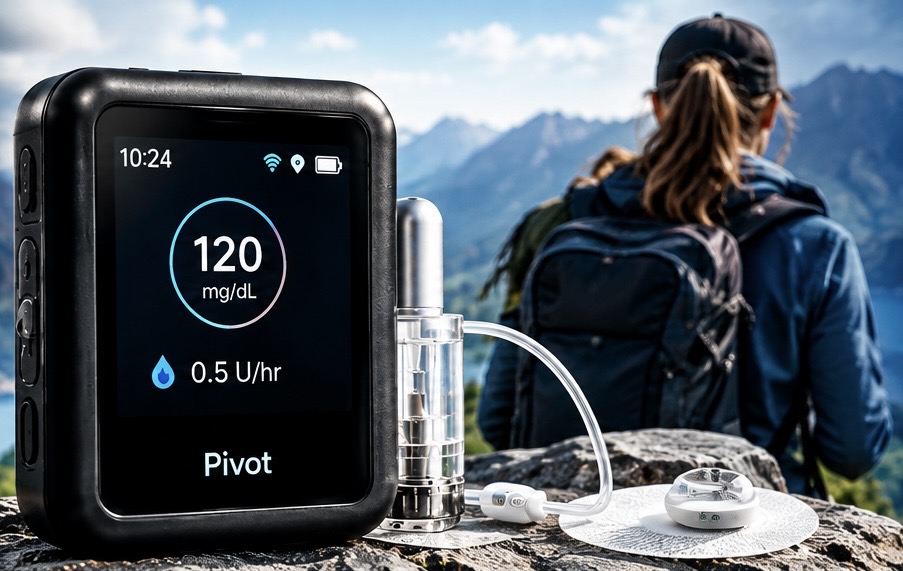
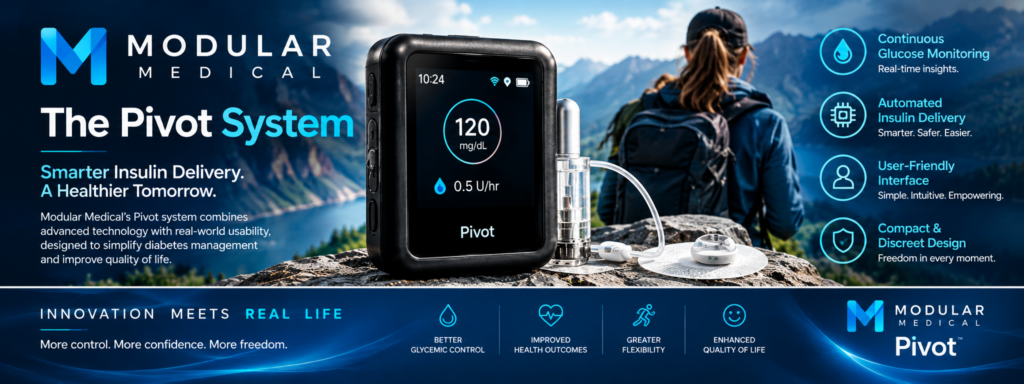
Modular Medical’s principal commercial focus is Pivot, a wearable insulin delivery system designed around a two-part patch-pump architecture.
The company describes Pivot as a tubeless insulin delivery system that integrates the infusion set beneath a removable pump. The design is intended to simplify the physical setup and everyday experience associated with insulin delivery.
The company’s broader product philosophy is based on reducing unnecessary complexity and making insulin pump therapy easier to learn and use.
For patients who have relied on injections, switching to an insulin pump can represent a substantial change in daily routines. Device setup, training, insurance approval, troubleshooting and ongoing treatment management can influence whether a patient chooses to adopt pump therapy and continues using it.
Modular Medical believes that a simpler design could help address some of these barriers.
The company also seeks to improve manufacturability and product usability, two factors that could influence its ability to manufacture devices efficiently and establish a sustainable commercial business.
However, product design alone does not guarantee adoption. Pivot must demonstrate that its usability, performance, cost and overall treatment experience are competitive with available alternatives.
From Regulatory Clearance to Commercialization
Modular Medical reached an important milestone in September 2024, when the FDA cleared its original MODD1 insulin pump for marketing and sale in the United States.
In August 2025, the company announced the first human use of MODD1 for insulin delivery. That milestone marked an important step in the development of its technology.
The company subsequently introduced Pivot as its next-generation patch-pump product.
After submitting a 510(k) premarket notification in November 2025, Modular Medical received FDA clearance for Pivot in April 2026. In June 2026, the company announced commercial availability and began initial shipments in the United States.
The company has stated that it does not intend to commercialize MODD1, shifting its commercial emphasis to Pivot.
These developments move the company’s story beyond the earlier stages of product development and regulatory review.
The next challenge is converting regulatory clearance into meaningful commercial adoption.
Initial shipments establish that a product has entered the market, but they do not independently demonstrate sustained demand, substantial revenue or profitability. Those outcomes depend on factors including physician acceptance, patient experience, reimbursement, distribution, manufacturing capacity and access to sufficient working capital.
For Modular Medical, the coming stages of commercialization will be central to determining whether its product strategy can translate into a durable business.
Sources: Modular Medical’s corporate disclosures and quarterly filing with the U.S. Securities and Exchange Commission.
An Industry Undergoing a Major Technological Transition
Diabetes management is increasingly shaped by advances in connected medical devices, glucose monitoring and automated insulin delivery.
Traditional insulin pump systems deliver insulin throughout the day through a pump and infusion set. Wearable patch pumps offer an alternative architecture by attaching the delivery device directly to the body, eliminating the need for conventional external tubing in the systems designed that way.
More advanced automated insulin delivery systems combine an insulin pump with glucose-monitoring technology and algorithms that adjust insulin delivery in response to glucose readings.
The American Diabetes Association’s 2026 Standards of Care recommend automated insulin delivery systems for many people with type 1 diabetes and support their use in appropriate patients with type 2 diabetes. Treatment decisions should reflect individual needs, preferences and clinical circumstances.
This evolving treatment landscape creates opportunities for medical device companies, but it also raises the competitive bar.
Established manufacturers have developed extensive product portfolios, physician relationships, patient-support services and distribution infrastructure. Some offer integrated pump and glucose-monitoring ecosystems, while others compete through wearable designs, simplified interfaces or different approaches to insulin delivery.
Modular Medical’s opportunity is therefore not simply to demonstrate that insulin pumps are useful. It must establish why patients, healthcare professionals and payers should consider its particular approach.
The Unmet Need: Patients Who Have Not Adopted Pump Therapy
One of the most important elements of Modular Medical’s market thesis is its focus on people who use insulin but have not adopted pump technology.
The company refers to this prospective customer group as “Almost Pumpers”: individuals who are aware of insulin pumps but may be reluctant to adopt them because of cost, complexity, time requirements or previous experiences.
In its fiscal 2026 annual report, Modular Medical estimated that approximately one-third of the 1.8 million Americans with type 1 diabetes used an insulin pump, while pump use among people with type 2 diabetes receiving intensive insulin treatment remained very limited.
These figures are company-reported market estimates, rather than an independent assessment of the entire global opportunity.
Nevertheless, the underlying commercial question is significant: can a more accessible device persuade additional insulin-dependent patients to consider pump therapy?
If a company can successfully reduce the barriers that prevent adoption, it may be able to serve patients who have historically remained outside the insulin pump market.
The opportunity, however, depends on more than the number of potential customers. Patients must also be appropriate candidates for the particular device, have access to clinical support, obtain any necessary insurance coverage and be willing to change their treatment routines.
Modular Medical’s strategy is built around the belief that a simpler product can help address some of those obstacles.
Competing in a Market Dominated by Established Players
The insulin delivery industry includes companies with substantially greater commercial resources, established customer bases and extensive healthcare distribution networks.
Among the best-known participants are Tandem Diabetes Care, Insulet Corporation and Medtronic.
Tandem Diabetes Care has built its business around insulin pump technology and integrated diabetes management solutions.
Insulet is known for its Omnipod wearable insulin delivery systems, which compete in the tubeless pump category.
Medtronic has a broad diabetes technology business that includes insulin pumps and automated insulin delivery systems.
These companies provide important reference points for understanding the market in which Modular Medical is attempting to establish itself.
Competition extends beyond the physical device. Companies must also address clinical confidence, product reliability, training, customer service, insurance reimbursement, replacement supplies and the quality of the overall patient experience.
For a smaller company, a focused product strategy may provide an opportunity to differentiate itself without replicating every feature offered by larger competitors.
Modular Medical’s potential advantage is its emphasis on simplicity, usability and manufacturing efficiency.
The central question is whether those attributes will prove compelling enough to generate adoption in a market where established competitors already have meaningful advantages in scale and distribution.
The company will also need to demonstrate that its product can meet patient expectations consistently as commercial volumes increase.
The Business Model: Turning Product Adoption Into Recurring Demand
Insulin delivery devices can support business models that combine initial equipment sales with recurring demand for compatible supplies and replacement components.
For a company commercializing a wearable insulin pump, this can create the possibility of a continuing customer relationship rather than a business based solely on one-time hardware sales.
However, the economics depend on the specific product configuration, pricing, replacement requirements, reimbursement arrangements and costs associated with manufacturing and distribution.
Modular Medical’s long-term commercial prospects will depend on its ability to develop an efficient route from prescription to delivery and continued use.
Important components of that process include:
- Establishing relationships with healthcare professionals and diabetes care teams.
- Educating potential users about the product and its intended use.
- Building distribution and customer-support capabilities.
- Navigating insurance coverage and reimbursement procedures.
- Manufacturing devices and compatible supplies consistently.
- Managing product costs while maintaining appropriate quality standards.
The company has indicated that it intends to expand Pivot’s commercial activities across metropolitan markets.
A focused geographic rollout could allow the business to develop its distribution and support processes before pursuing broader expansion.
Nevertheless, expanding into new markets requires resources. The company must balance commercial investment against the need to preserve sufficient capital for manufacturing, product development, regulatory work and general operations.
Financial Position: A Critical Issue for Investors
While Modular Medical has achieved important regulatory and product milestones, its financial position remains one of the most significant factors in evaluating the business.
According to its Form 10-Q for the quarter ended June 30, 2026, the company reported:
- Cash and cash equivalents: approximately $3.92 million.
- Research and development expenses: approximately $4.37 million for the quarter.
- Selling, general and administrative expenses: approximately $2.17 million for the quarter.
- Total operating expenses: approximately $6.54 million for the quarter.
- Net loss: approximately $6.49 million for the quarter.
The company reported a net loss of approximately $6.70 million for the corresponding quarter in 2025.
Although operating expenses declined year over year, the company continued to report substantial losses.
The filing also reported an accumulated deficit of approximately $119 million as of June 30, 2026.
These figures illustrate the financial challenge facing a medical device company moving from development into early commercialization.
Regulatory clearance and product availability are important achievements, but commercial growth requires continued spending on manufacturing, product refinement, sales, distribution, customer support and regulatory compliance.
A company in this position must demonstrate that its available capital and any future financing can support its operating plan long enough for commercialization to develop.
The Importance of Future Financing
Modular Medical has historically relied on external financing to support its operations.
In April 2026, the company completed a registered direct offering of 750,000 shares of common stock, generating approximately $3.375 million in gross proceeds before offering expenses.
Equity financing can provide important resources for product development and commercialization, but issuing additional shares can dilute existing shareholders.
The company’s June 2026 quarterly filing also stated that it did not yet have revenue sufficient to cover operating expenses through internally generated cash flows.
Management identified conditions that raised substantial doubt about the company’s ability to continue as a going concern for at least one year from the issuance of those financial statements.
This disclosure is an important consideration for investors.
It does not mean that the company will necessarily cease operations. It does mean that its ability to continue executing its plans depends on its financial circumstances, operating performance and access to additional capital.
Investors should therefore monitor subsequent SEC filings for updated cash balances, operating expenses, financing transactions, outstanding share counts and any reported commercial revenue.
The company’s financial position could change materially as it raises capital, increases commercial activity or adjusts its spending.
International Expansion Could Provide Another Growth Avenue
Beyond the U.S. market, Modular Medical has identified international regulatory clearance as part of its longer-term strategy.
The company has stated that it intends to pursue Conformité Européenne, or CE, marking for Pivot, which would support its ability to market the product in Europe and certain other markets, subject to applicable requirements.
Its fiscal 2026 annual report identified the second quarter of 2027 as an expected timeframe for CE marking.
That timeframe is a company target, not a guarantee of regulatory approval.
International expansion could increase the number of potential markets available to the company, but it would also introduce additional requirements involving regulatory compliance, distribution, reimbursement, manufacturing and customer support.
Different healthcare systems have different rules for medical device access and reimbursement. Establishing a presence in another country therefore requires more than obtaining regulatory authorization.
For a company with limited financial resources, international expansion must be balanced against the need to establish a viable business in the United States.
Successful execution could broaden the company’s commercial opportunities. Delays or unexpected costs could place additional pressure on its financial position.
Product Development and Manufacturing Remain Important
Modular Medical has also identified improvements in Pivot’s manufacturability and usability as ongoing priorities.
These efforts are relevant because medical device companies must satisfy several requirements simultaneously.
A product must function reliably, meet regulatory standards, be suitable for its intended patients and be manufactured consistently. It must also be commercially viable at a price that customers and payers can support.
Manufacturing improvements can potentially reduce unit costs, increase production efficiency and help a company respond to rising demand.
However, those benefits must be demonstrated through actual manufacturing performance and commercial results.
For Modular Medical, investors will want to see evidence that the company can produce Pivot consistently, manage production costs and scale distribution without creating additional financial or operational difficulties.
Further product development may also help the company refine the user experience and address feedback from healthcare professionals and patients.
The challenge is to balance those improvements against the costs of operating a growing medical device business.
Management Experience and Strategic Direction
Modular Medical’s leadership brings experience in medical devices, diabetes technology, financial management and capital markets.
Founder and President Paul DiPerna has more than 30 years of medical device industry experience and has been involved in diabetes care for approximately two decades.
According to the company’s corporate biography, DiPerna previously founded and led a diabetes delivery technology business that became Tandem Diabetes Care. He has also worked on medical device technologies involving blood-borne infection control and micro-pumping systems.
Chief Executive Officer James (Jeb) Besser brings experience in public equity markets, life sciences, technology and corporate strategy. The company identifies him as a long-standing participant in developing its commercial strategy.
Interim Chief Financial Officer James Sullivan has more than 30 years of financial management and accounting experience, including previous CFO positions at technology companies.
This background provides relevant experience as Modular Medical attempts to transition into a commercial-stage medical device business.
Nevertheless, management experience does not eliminate the challenges associated with launching a new product. The company’s long-term prospects will ultimately depend on execution, customer adoption, manufacturing performance and financial sustainability.
Potential Catalysts to Watch
Several developments could influence Modular Medical’s outlook as it continues commercializing Pivot.
1. Commercial adoption in the United States
Evidence of increasing product adoption would help investors assess whether Pivot is gaining traction with patients and healthcare professionals.
Commercial availability and initial shipments are early milestones. Sustained orders, repeat demand and reported revenue would provide more meaningful evidence of market acceptance.
2. Revenue growth
Reported revenue, if and when it becomes material, will be an important measure of whether the company’s commercial strategy is gaining traction.
Investors should distinguish between initial shipments, recognized revenue and recurring commercial demand.
3. Manufacturing efficiency
Improvements in manufacturing processes could support more consistent production and potentially improve the economics of the business.
The relevant evidence will be actual production performance, costs and the company’s ability to meet demand.
4. Insurance coverage and reimbursement
Access to appropriate reimbursement can influence whether patients can obtain and continue using insulin pump technology.
Progress in this area could support adoption, although the effects would depend on the coverage arrangements secured and the number of eligible patients reached.
5. International regulatory progress
Updates on CE marking and other international regulatory processes could clarify the timing and scope of potential expansion beyond the United States.
6. Additional financing
New financing could provide resources for commercialization and product development.
However, investors should also assess the associated costs, financing terms and potential dilution.
7. Quarterly financial results
Cash balances, operating expenses, net losses, share issuance and management’s assessment of available resources will remain important indicators of the company’s ability to execute its strategy.
Key Risks Investors Should Consider
Modular Medical’s commercial opportunity is accompanied by substantial risks.
Commercial execution risk: FDA clearance does not guarantee widespread adoption. The company must establish relationships with healthcare professionals, patients, distributors and payers.
Competition: Established insulin pump manufacturers have existing products, distribution networks and customer-support infrastructure.
Financing risk: Continued operating losses and limited cash resources could require additional capital raises. Financing may not be available on favorable terms.
Shareholder dilution: Additional equity issuance could reduce existing shareholders’ ownership percentages.
Manufacturing risk: Production problems, quality issues or higher-than-expected costs could affect product availability and margins.
Regulatory risk: International expansion and future product modifications may require additional regulatory work, time and expense.
Reimbursement risk: Insurance coverage, patient out-of-pocket costs and administrative requirements could influence adoption.
Product performance and safety: Insulin delivery devices must perform reliably. Product failures, infusion problems or other safety concerns could affect patients and expose a manufacturer to regulatory, financial and reputational consequences.
Going-concern uncertainty: The company’s June 2026 quarterly filing explicitly identified substantial doubt regarding its ability to continue as a going concern for at least one year from the financial statement issuance date.
These factors make it important to evaluate the company’s operational progress alongside its financial disclosures rather than relying exclusively on its technology or addressable-market estimates.
The Bigger Picture: A Potential Opportunity, Not a Guaranteed Outcome
Modular Medical is pursuing a specific opportunity within the broader diabetes technology industry: making insulin pump therapy more accessible to people who have not adopted existing systems.
Its Pivot product is designed around a simpler, tubeless wearable architecture, and its regulatory clearance and initial U.S. commercial shipments represent meaningful steps in the company’s development.
The underlying market challenge is credible. Treatment complexity, cost, insurance access and the time required to learn diabetes technology can influence whether patients adopt particular devices.
However, identifying an unmet need and building a product to address it are only the first stages of creating a successful medical device business.
Modular Medical must now demonstrate that Pivot can attract sustained demand, compete effectively against established manufacturers, achieve viable manufacturing economics and generate sufficient financial resources to support continued operations.
International expansion and additional product development could provide longer-term opportunities, but both will require investment and successful execution.
For investors, the company’s story is therefore defined by the intersection of medical technology, commercial execution and financing risk.
The opportunity lies in whether Modular Medical can translate its simplified insulin delivery approach into a commercially sustainable product that reaches more patients.
The challenge is whether the company can achieve that objective before its financial resources become a more significant constraint.
The next phase will be measured not only by regulatory and product milestones, but by evidence of adoption, revenue generation, manufacturing efficiency and financial stability.
Company information and financial figures in this article are based on Modular Medical’s publicly available corporate disclosures and its Form 10-Q for the quarter ended June 30, 2026. Industry context includes the American Diabetes Association’s 2026 Standards of Care in Diabetes. Company targets and market estimates are identified as such and should not be interpreted as guaranteed outcomes.
This article is for informational purposes only and does not constitute investment advice or a recommendation to buy or sell securities.